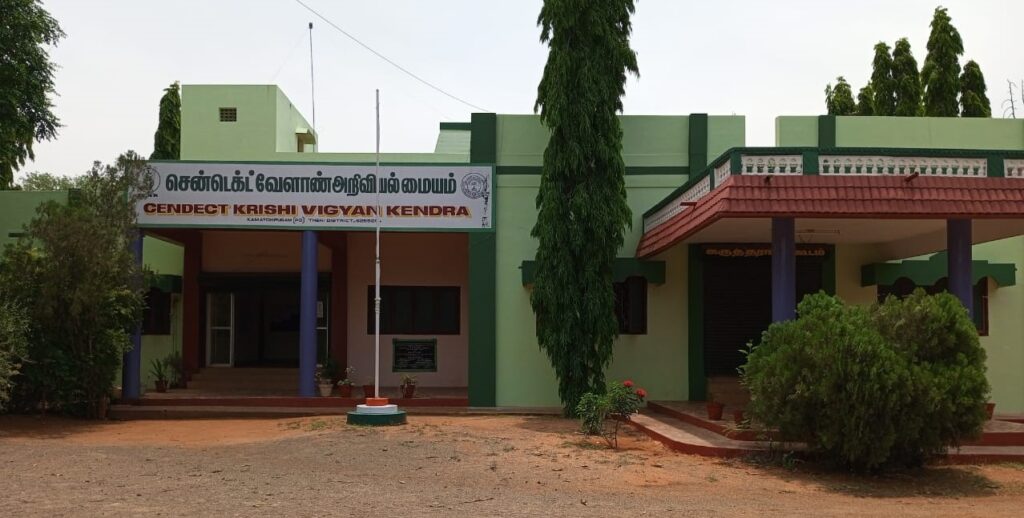
Krishi Vigyan Kendra (Farm Science Centre) in India is a unique system of technology transfer. Started its service on 21st March 1974 at Puducherry, the first KVK in India, grown to 731 KVKs in 2023. As the frontline extension system, KVKs have their footprint in every successful technology developed by institutions and adopted by farmers.... |
Indian Council of Agricultural Research (ICAR), Government of India mandated the establishment of Krishi Vigyan Kendras as grassroots level Farm Science Centres to provide various types of farm support activities like technology dissemination to farmers, training, awareness to achieve the set of objectives. KVK have made dent and has become part of decentralized planning and implementation instrument to achieve desired level of growth in agriculture and allied sector in the district.
KVK play a vital role in conducting on farm testing to demonstrate location specific agricultural technologies. KVK conducts demonstrations to prove the potential of various crops at farmers’ fields. Also conduct need based training programmes for the benefit of farmers and farm women, rural youths. KVK creates awareness about improved agricultural technologies through extension programmes. Critical and quality inputs like seeds, planting materials, organic products, bio fertilizers and livestock are produced by the KVK and made available to the farmers.
Technology assessment, refinement and demonstration of technology/products through the following activities of KVK.
- On-farm testing to identify the location specificity of agricultural technologies under various farming systems.
- Frontline demonstrations to establish its production potentials on the farmers’ fields.
- Training of farmers to update their knowledge and skills in modern agricultural technologies, and training of extension personnel to orient them in the frontier areas of technology development.
- To work as resource and knowledge centre of agricultural technology for supporting initiatives of public, private and voluntary sector for improving the agricultural economy of the district.
- In order to create awareness about improved technology, a large number of extension activities will be taken up.
- The seeds and planting materials produced by the KVKs will also be made available to the farmers.
Skill Training
Event Details:
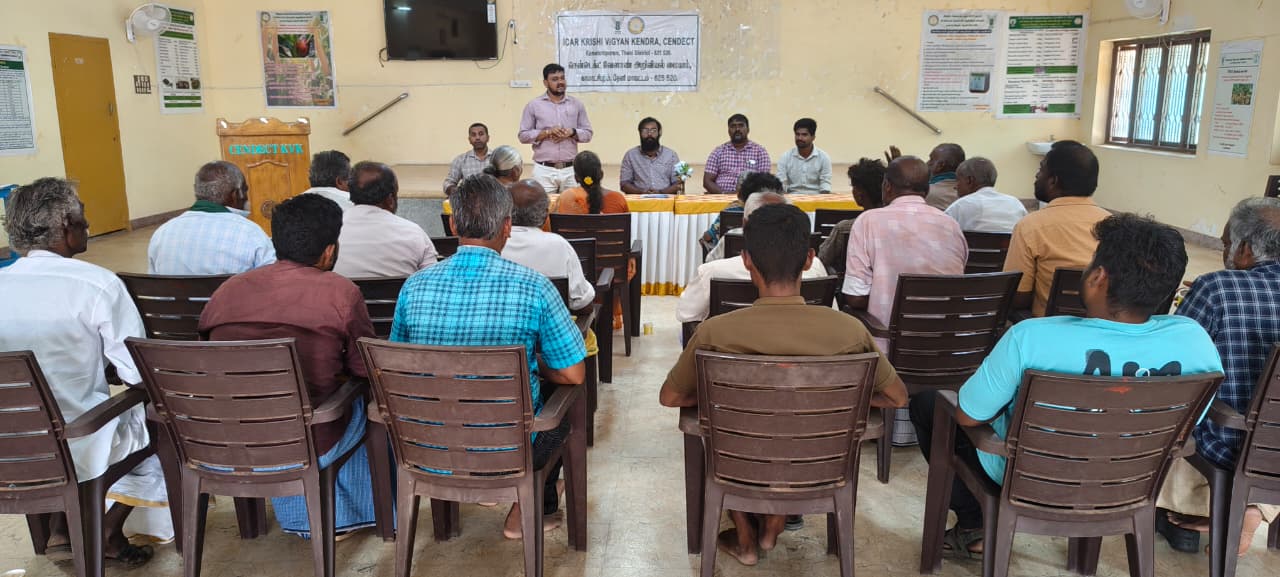
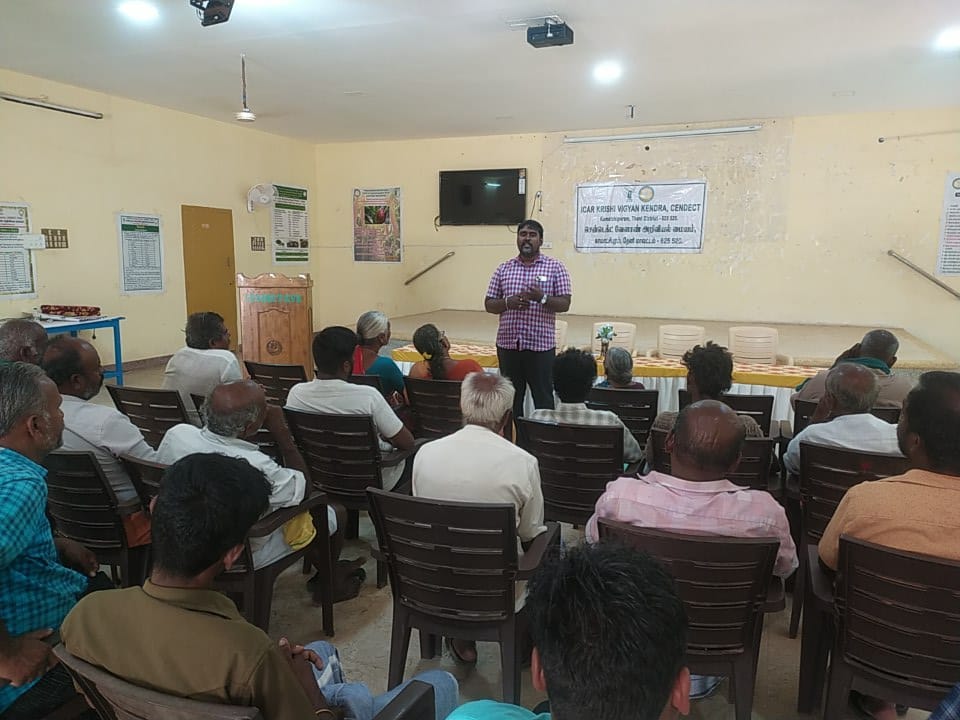
Conducted a Skill Training Programme on Value Addition in Mango at the KVK premises.
• Provided an overview of KVK mandated activities and services.
• Delivered a technical session on recent trends in the food processing sector, emphasizing the importance of food processing, post-harvest management and value addition of locally available seasonal fruits.
• Demonstrated Amchur, Mango Leather, Protein-Enriched Mango Bar, Mango Halwa and Mango Pickle and Thokku.
• Explained the procedures for licensing, branding, packaging, marketing strategies and various Government schemes available for food processing entrepreneurs.
• Shared success stories of KVK promoted entrepreneurs to motivate the participants.
• Distributed technology pamphlets and participation certificates to all trainees.
• Conducted pre- and post-training assessments and collected participant feedback.
• Created awareness about the Khet Bachao Abhiyan campaign among the participants.
Extension functionaries training
Event Details:
1. A training programme was organised for extension functionaries including Assistant Director of Agriculture (ADA), Agricultural Officers (AOs) and Assistant Agricultural Officers (AAOs) to enhance their technical knowledge on Direct Paddy Sowing (DPS) methods and improved Kharif paddy cultivation technologies.
2. The programme aimed to strengthen the capacity of field-level officials for effective dissemination of recommended technologies among farmers during the Kharif season.
3. We have updated extension functionaries on recent advancements in direct paddy sowing techniques and provided technical knowledge on scientific Kharif paddy cultivation practices.
4. We have given improved field-level advisory services for farmers and promoted water-saving and cost-effective paddy production technologies.